


Projects funded by the European Regional Development Fund
For modern optoelectronic applications, new semiconductor materials must be developed that are both long-term stable and have suitable properties and are inexpensive in order to enable new technologies. In the ERDF project funding this X-ray diffractometer (XRD), electronically and optically active materials are researched that are based on novel crystal structures or on new nanoscale forms. In order to identify the materials and characterize them crystallographically, they have to be measured using the XRD. The ERDF-funded compact X-ray diffractometer offers fast and reliable characterization of the crystallographic properties of these new materials.
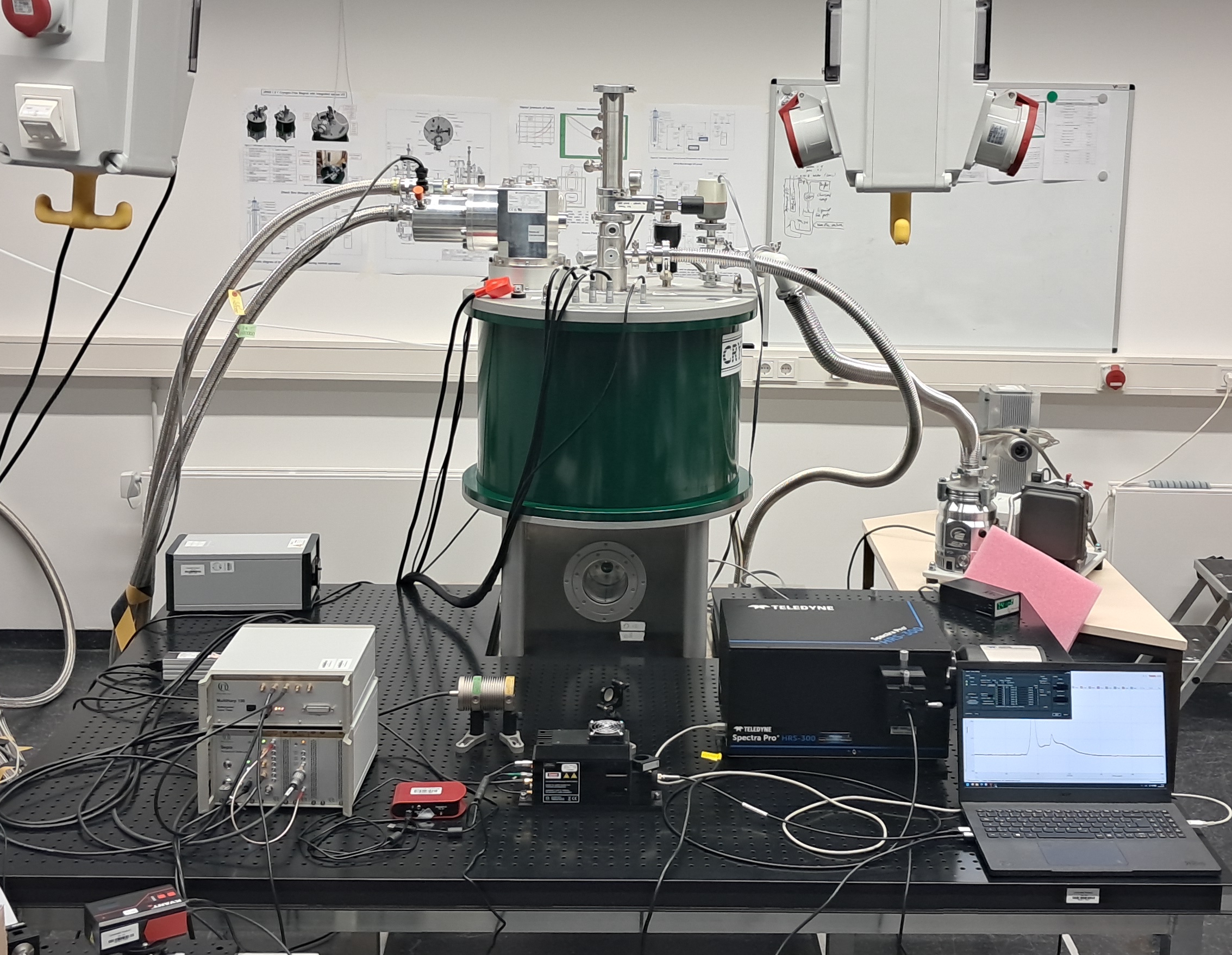
Modern low-dimensional semiconductor nanostructures are investigated for their electronic properties using time-resolved spectroscopy (components provided by PicoQuant), which is funded by the European Regional Development Fund of the European Union. The temporal resolution allows for the identification and quantification of optical decay processes. Low temperatures cause lattice vibrations, which lead to the premature relaxation of excited states, to be "frozen out." Studying the temperature dependence of absorption and fluorescence (optical emission) also enables the identification and investigation of thermally activated processes. Applied magnetic fields allow for the exploration of processes that depend on the spin orientation of the electrons. These complex characterization capabilities make it possible to improve the synthesis of nanomaterials with regard to, for example, surface passivation and quantum yield. The goal is then to electronically contact the optimized two-dimensional structures individually using electron beam lithography, thereby investigating their optoelectronic properties and producing actual optical elements such as active and passive color filters as well as optoelectronic components, such as transistors, LEDs, solar cells and sensors.
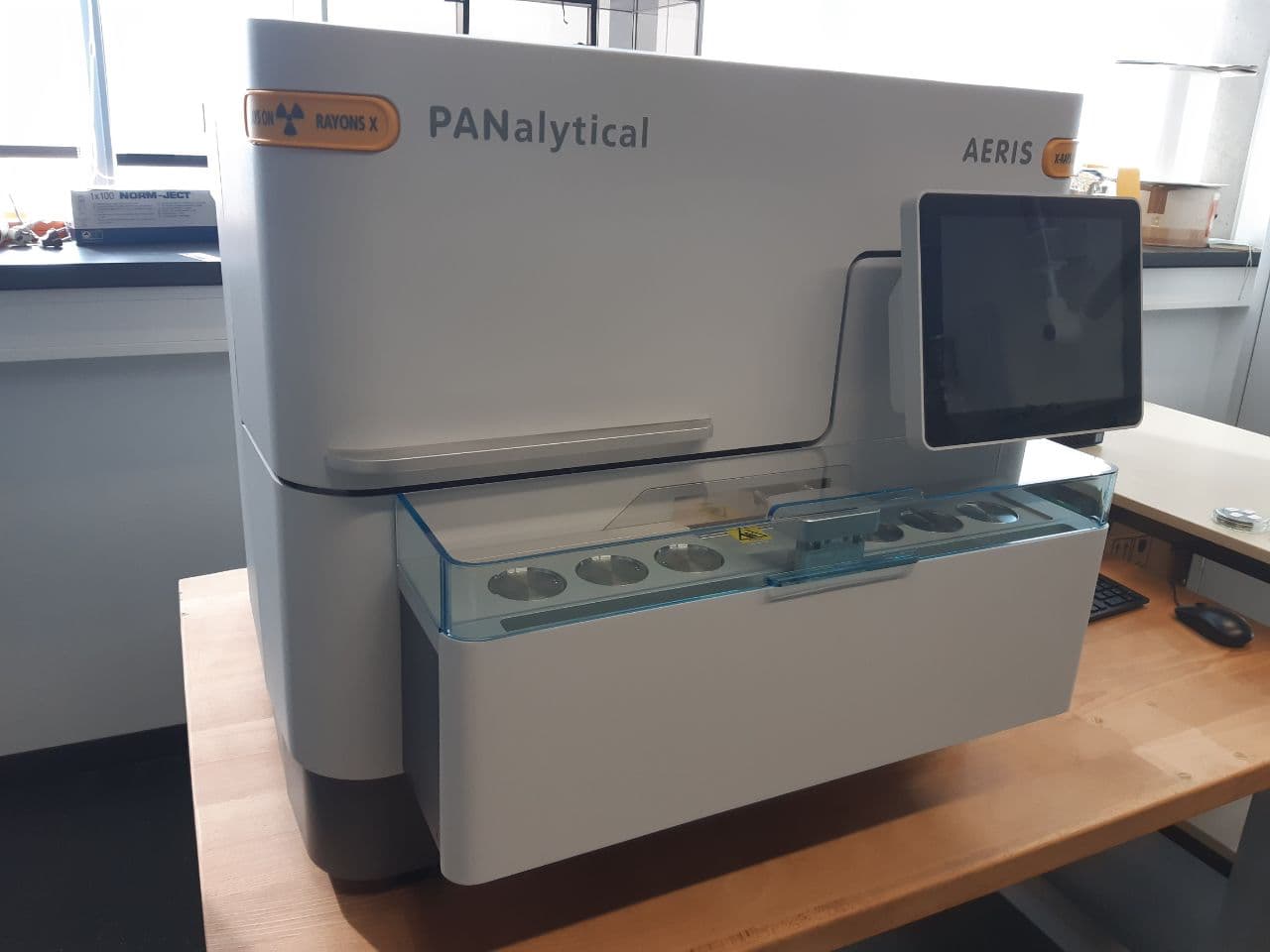
The X-ray diffractometer (Aeris by Malvern Panalytical), which is funded by the European Regional Development Fund of the European Union, allows crystal phase identification of powder samples. The instrument provides fast, reliable and accurate material analysis. It includes a robotic 6-position sample charger, a 300 W Cu X-ray tube, Bragg-Brentano geometry, and a 2theta range from -4° to +142°.
For modern optical applications, new materials are always required that are both long-term stable and have high fluorescence quantum yields and at the same time are inexpensive in order to enable new technologies. Such modern optoelectronic structures will be developed and spectroscopically characterized as part of this EFRE project. The EFRE-funded fluorescence spectrometer allows optical processes to be understood and quantified in detail, even in a time-resolved manner. This in turn allows the syntheses of the relevant nanomaterials to be improved.
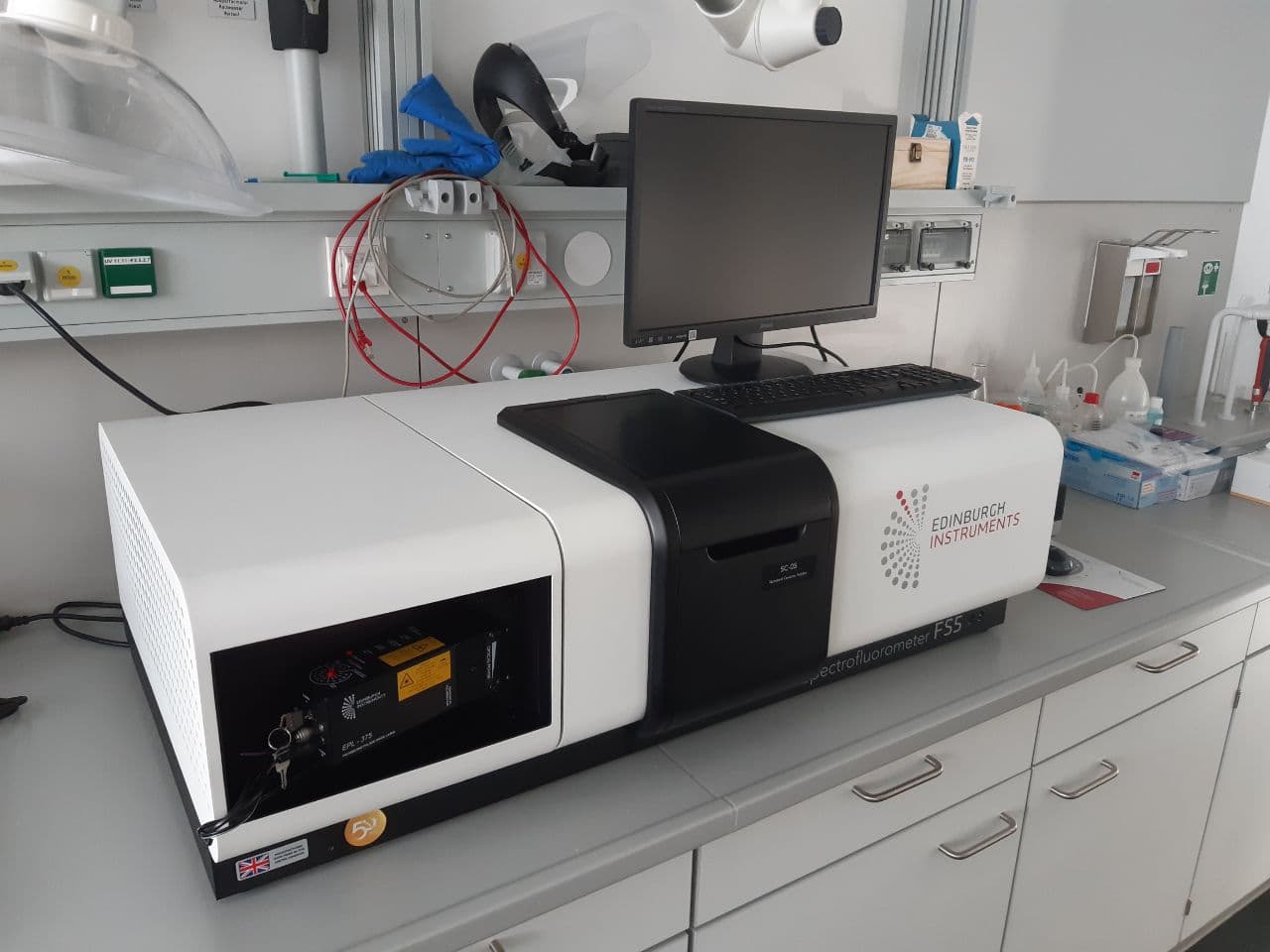
The fluorescence spectrometer (FS5 by Edinburgh Instruments), which is funded by the European Regional Development Fund of the European Union, allows steady state and time-resolved photoluminescence measurements of molecules and solid state materials in solution and in dry state. The instrument, which includes an integration sphere, provides fast, reliable and accurate analysis of the materials' optical properties in the range from 200 nm to 900 nm with a time resolution down to about 200 ps.